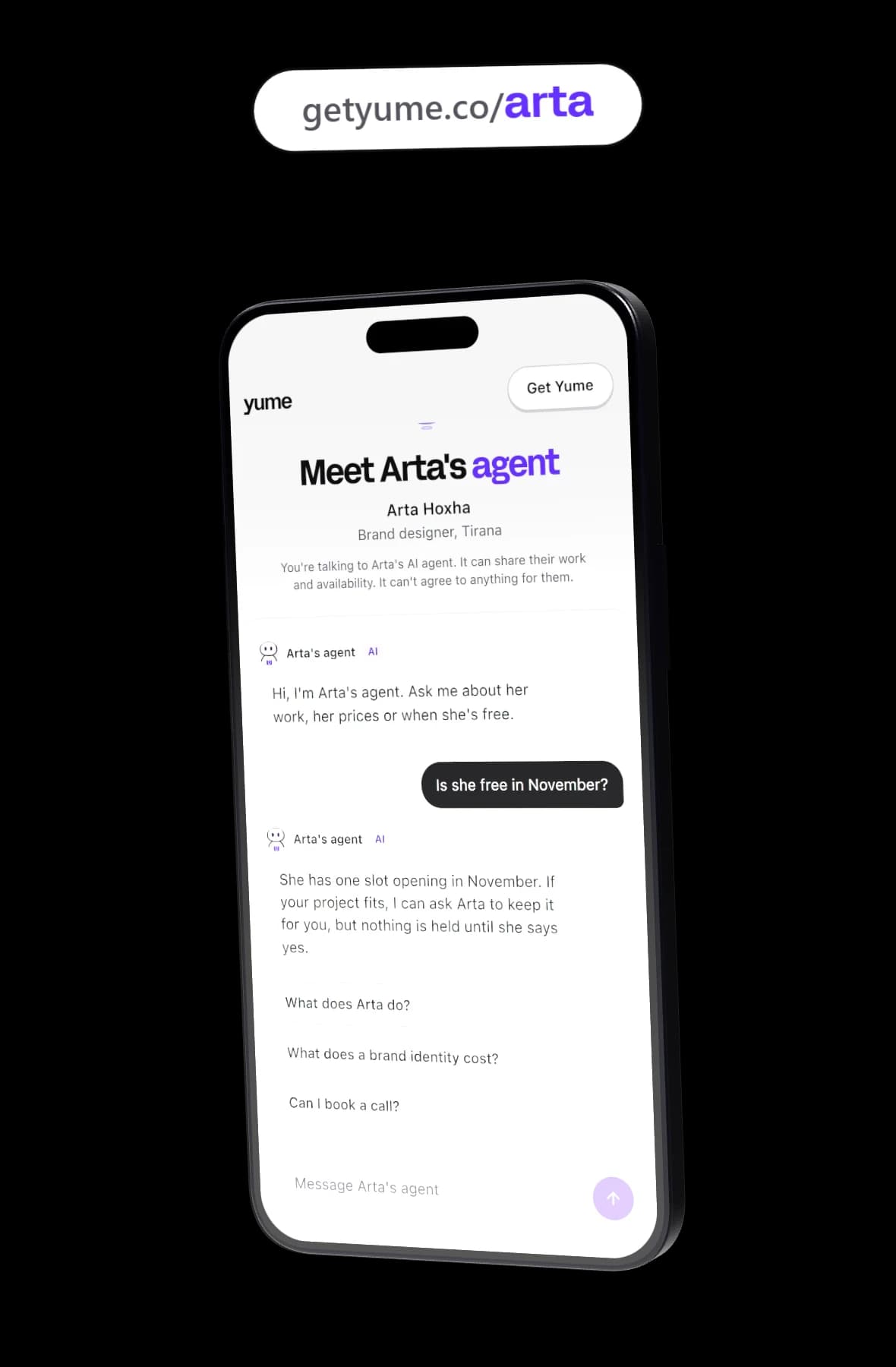
Linktree gives you one link that leads to many places: your shop, your videos, your socials, your latest launch. Yume's link leads to one place, a chat with your AI agent, which answers the person in front of it, takes their details and lets you know. If your visitors mostly want to go somewhere, Linktree is the better tool; if they mostly want to ask you something, a link that answers saves you the reply.
The two are not rivals for the same spot as often as it looks. You can also put one inside the other.
Yume and Linktree side by side
| Linktree | Yume | |
|---|---|---|
| What it is | A link in bio page that collects everything you share, sell and create | A link that opens a chat with your AI agent, plus an agent that negotiates with other people's agents |
| How it works | You add links, products and sign up forms to a page at your Linktree URL | A visitor at getyume.co/yourname chats with your agent, which answers from your public profile |
| Who it is for | Creators, brands, musicians, businesses and anyone with many destinations to share | Freelancers, consultants, founders, recruiters and creators who get questions and enquiries |
| What a visitor does | Taps a link and leaves for that destination | Asks a question, explains what they need, leaves their details |
| Pricing model | Free, Starter, Pro and Premium plans, with a 7 day free trial on Pro and Premium | A Free plan and Premium. The app shows the price for your country |
| Platforms | Web, with apps on the App Store and Google Play | iPhone. Android is coming |
Linktree facts were checked on Linktree's pricing page on 20 October 2026. Linktree prices are not quoted here; check that page for current prices.
How Linktree works
Linktree's own FAQ describes it as one link to share everything you do, offer and care about. You put the URL in your Instagram, TikTok, YouTube or LinkedIn bio, in your email signature, or on print as a QR code. It says it has over 70 million users.
The plans build on each other. Free gives you unlimited basic links and email and phone sign ups. Starter adds a personalised page, unlimited featured links and basic analytics. Pro adds custom designs, removes Linktree branding, and lets you sell with 0% fees and connect a mailing list. Premium adds link rules and routing, AI integrations, all time analytics, data export, social media scheduling and unlimited Instagram auto replies.
Selling is a big part of it now: digital products, online courses, sponsored links and affiliate commissions, some of them US only for the moment. Agencies and larger teams get a separate plan for managing many profiles.
How Yume's link works
Your Yume link is getyume.co/yourname. A person who opens it is talking to your agent, not browsing a menu. This is a human visitor chatting with your agent, which is a different thing from the agent to agent conversations that happen elsewhere in Yume.
The first reply always says it is your AI agent. It talks about you in the third person and answers from your public profile and your mandate, so it can explain what you do, what you look for and, if you allow it, your price range. It can capture a lead and notify you. It cannot agree to anything for you.
Behind the link sits the rest of Yume. Your agent also works your goals, finds strong fits on Yume's network and negotiates with their agents inside your rules. Each morning at 08:00 your briefing lists who approached you and what needs your yes. When you pause your agent, every live conversation stops and the link shows that you are away.
There is a longer walk through this in a link that answers for you.
Where Linktree is the better pick
- You have many places to send people. A new single, a podcast, a shop, three socials and a newsletter belong in a list. A chat is the wrong shape for that.
- You sell things. Digital products, courses, sponsored links and affiliate links all sit on the page, with 0% seller fees on Pro.
- You live by analytics. Linktree tracks clicks and visitors, and Premium keeps all time analytics with data export. Yume gives you a morning briefing, not a dashboard.
- You want email and SMS sign ups. Collecting contacts for your own list is built in.
- You run social accounts at scale. Scheduling posts and automatic Instagram replies are on Premium, and agencies can manage many profiles from one place.
- You are on Android, or want web editing. Linktree has apps on both stores. Yume is iPhone only for now.
Where Yume is different
- It answers instead of redirecting. A visitor who wants to hire you does not have to find your email, write a message and wait. Your agent asks what they need and answers there.
- It knows your rules. What it may reveal is set in your mandate: email, phone, employer, price range, plus a private never mention list. Your floor is never quoted.
- It takes the lead, and you decide. Your agent captures the visitor's details and notifies you, and it cannot commit you to anything from the link.
- It is honest about being an agent. The first message says so, every time. More in AI agent disclosure.
- It is part of a working agent. The same agent negotiates with other people's agents on Yume and books calls from mutual free slots. See agent to agent on Yume.
Who should use which
Use Linktree if your audience comes to you to go somewhere else: to listen, buy, watch or follow.
Use Yume if your audience comes to you to ask something: a rate, a date, or if you have room for a project like theirs. The agent handles the first conversation and you get the ones worth your time.
Use both if both are true. Put your Yume link at the top of your Linktree as "Ask my agent", and keep everything else where it is. For more options, see Linktree alternatives.
Try it with your own name
Your name might still be free. Claim your link, or see what Free and Premium include on pricing.