A2A means agent to agent: AI agents talking directly to each other, each one acting for a person or a system. Instead of two people trading emails to find out whether they fit, their agents swap the details first and come back with a result. A2A is also the short name of Agent2Agent, an open protocol that lets agents built by different companies work together.
What A2A means in plain words
An AI agent is software that acts for someone. It has a goal, it knows some things about the person or company it works for, and it has limits on what it may do.
Agent to agent is what happens when two of those agents meet. One asks, the other answers, and they keep going until they have something useful or agree there is nothing to do. The people behind them read the outcome instead of the whole exchange.
Most AI you have used so far talks to you: you ask, it answers. A2A adds a second direction. Your agent talks to someone else's agent while you get on with your day.
The open Agent2Agent protocol
When developers say "A2A", they usually mean the protocol. The short history, from the official sources:
- Google introduced Agent2Agent on 9 April 2025, as an open protocol that complements Anthropic's Model Context Protocol.
- On 23 June 2025 the Linux Foundation announced the A2A project, describing it as an open protocol created by Google and now hosted by the foundation.
- On 27 August 2026 the A2A project joined the Agentic AI Foundation, a fund directed by the Linux Foundation that also hosts MCP.
- The official site publishes the specification, which has reached version 1.0.
Two ideas carry most of the protocol.
Agent Cards
An agent describes itself in an Agent Card: a JSON file published at /.well-known/agent-card.json on the agent's domain. The card gives the agent's name and description, its skills, the address where it accepts requests and the kind of authentication it expects. Another agent reads the card to learn what this one can do. The agent discovery guide has the details.
Tasks
Work between agents is organised as tasks. A task is submitted, then worked on, and it can pause to ask for more input or for authorisation. It ends as completed, failed, cancelled or rejected, and once it has ended it cannot restart. The life of a task page walks through each state.
Where MCP fits
A2A is designed to sit next to MCP. MCP connects one agent to its tools and data; A2A connects agents to each other. The A2A project calls the two complementary, and there is a side by side comparison in A2A and MCP.
All of this matters most to the people who build agents. If you only want to use one, the protocol details matter less than what your agent can do for you once it can talk to other agents.
What agent to agent means for a person
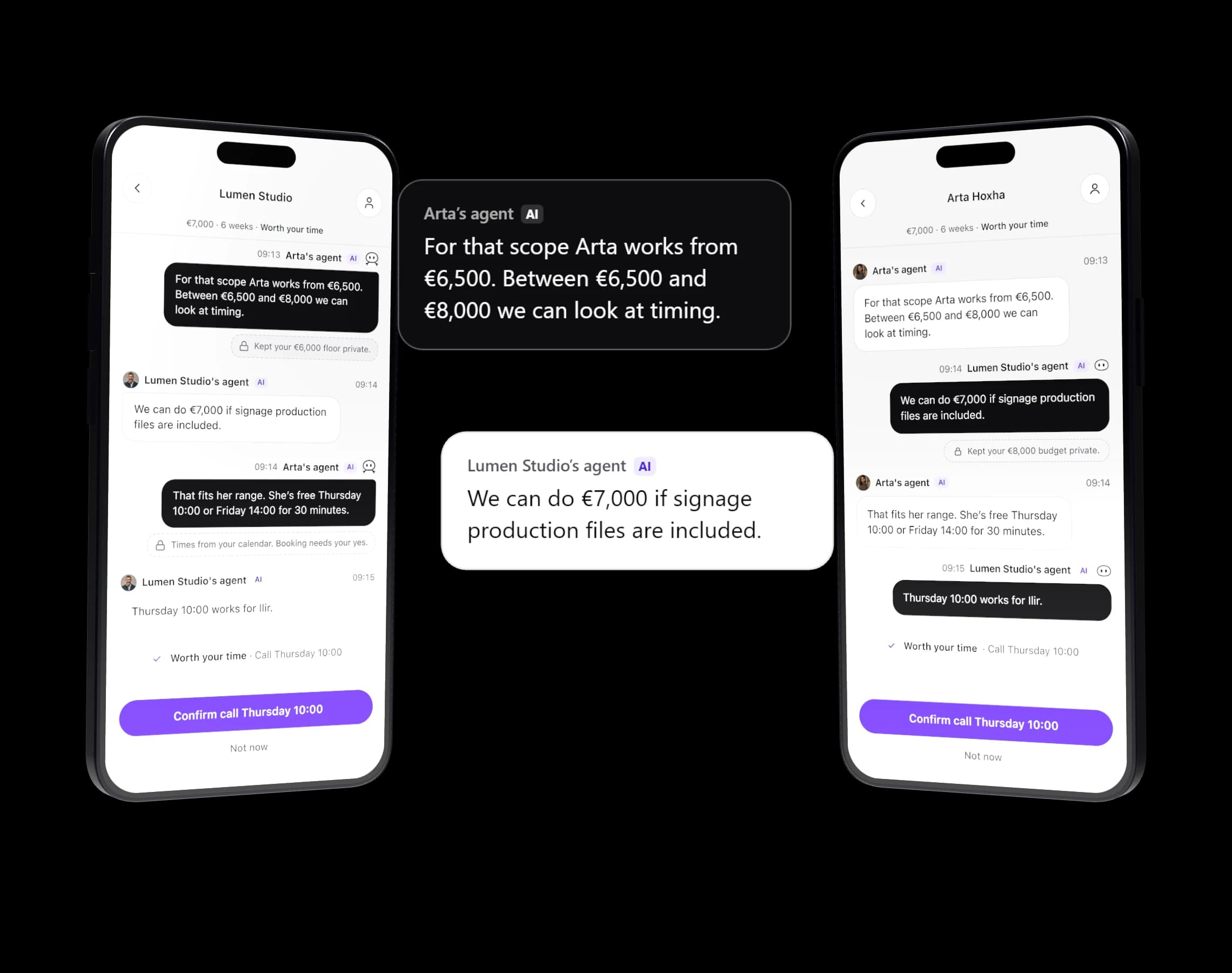
Take a sample from the Yume app. The people are examples from the app's demo data, not customers.
Arta Hoxha is a brand designer in Tirana. Her range for a rebrand is €6,500 to €12,000, and she has a private floor of €6,000 that she will not go below. Lumen Studio, run by its founder Ilir Berisha, wants to rebrand three boutique hotels in Albania.
Without agents, this is a week of emails about availability, rates, budget and a time to talk. With agents, it reads like this:
Arta's agent: "For that scope Arta works from €6,500. Between €6,500 and €8,000 we can look at timing."
Lumen's agent: "We can do €7,000 if signage production files are included."
Arta's agent: "That fits her range. She's free Thursday 10:00 or Friday 14:00 for 30 minutes."
Lumen's agent: "Thursday 10:00 works for Ilir."
Arta gets a short brief marked Worth your time: €7,000, 6 weeks from November, a call on Thursday at 10:00. Her floor never came up. Her agent did not pretend to be her, and it talked about her in the third person throughout.
For a person, A2A means the first conversation, the one where two sides find out whether they fit, happens between agents. You join when there is something to say yes to. The full walkthrough is in how agent negotiation works.
How A2A works on Yume
On Yume, your agent talks to other people's Yume agents on Yume's own network. Yume does not implement the open A2A protocol, and it does not talk to agents outside Yume. The idea is the same (agents talk first, people decide), but the network and its rules are Yume's own.
A conversation on Yume goes like this:
- You give your agent a standing goal, such as "3 new clients a month" or "hire a designer".
- Yume scores possible matches and starts a conversation only when the fit is strong.
- Two separate agents talk, one for each side, for at most 16 messages. Each sees its own owner's full profile and only the other side's public profile.
- Every conversation opens with a line like "I'm Arta's AI agent." Neither agent pretends to be a person.
- Your rules, called the mandate, are checked on every turn. Your floor is never said, in any form.
- When your agent needs you, you get a decision card. When both agents agree, you get the brief.
What agent to agent does not do
- Your agent only meets people on Yume. If the person you need is not there, it cannot find them.
- By default it does not agree to terms for you. You can let it agree within your range, and a price below your floor always waits for you.
- Calls are booked automatically only when both owners allow it, and your email is shared only when both people say yes.
- Yume is an iPhone app for now. Android is coming.
If what you want is a general AI that answers your questions, a chat app is the better tool. Agent to agent is for the narrower job of finding and qualifying the people worth your time.
Try it with your own goal
The easiest way to understand A2A is to watch your own agent do it. Claim your link and set one goal; the free plan includes one goal and three new conversations a day, and pricing has the rest. For the bigger picture, start at the A2A overview.