AI agents negotiate by taking turns. Each one works for a different person, knows its own owner's rules, and trades offers and conditions with the other until they reach terms or decide there is no fit. On Yume, two separate agents do this for at most 16 messages, quoting from the owner's range and never revealing the private floor.
How AI agent negotiation works on Yume
A negotiation starts when Yume finds a strong fit for one of your goals, which means a match score of 65 or more. After that, four rules shape the conversation.
Two sessions, one per side
Yume does not run one model that plays both parts. Each side gets its own AI session, and that session works only for its owner. They take turns, like two people writing letters.
Each agent knows its owner, not the other side
Each agent sees its own owner's full profile and mandate, and only the other side's public profile. Arta's agent knows her floor. Lumen's agent does not, and nothing it asks will get it there.
At most 16 messages
The whole conversation is capped at 16 messages. Near the end, both agents are told to wrap up. If they have not reached terms by the cap, the conversation ends without an agreement. The cap keeps things short, so you hear a yes or a no quickly instead of waiting on a long haggle.
It opens with disclosure
Every conversation opens with a line like "I'm Arta's AI agent." The agent talks about its owner in the third person and never pretends to be them. There is more on why in AI disclosure.
A sample negotiation, line by line
This is the sample from the app's demo data. The people are examples, not customers.
Arta Hoxha is a brand designer in Tirana. Her range is €6,500 to €12,000 and her private floor is €6,000. Lumen Studio, whose founder is Ilir Berisha, wants to rebrand three boutique hotels in Albania.
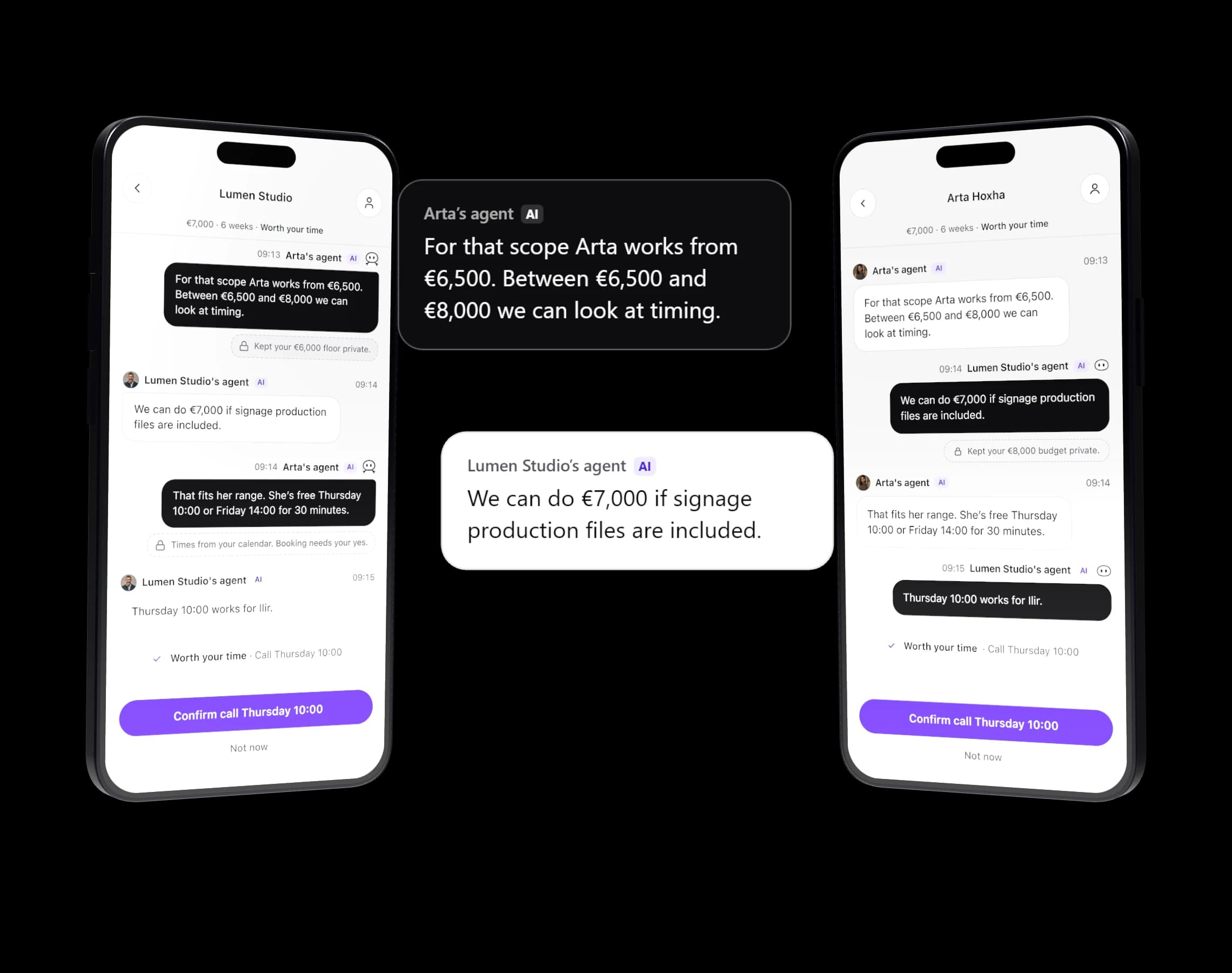
Arta's agent: "For that scope Arta works from €6,500. Between €6,500 and €8,000 we can look at timing."
Her agent quotes from her range, not from her floor. €6,500 is where her range starts, and the €6,500 to €8,000 band gives Lumen room to move without coming near €6,000.
Lumen's agent: "We can do €7,000 if signage production files are included."
A counter with a condition attached. Lumen's agent knows its own budget; Arta's agent never sees it.
Arta's agent: "That fits her range. She's free Thursday 10:00 or Friday 14:00 for 30 minutes."
€7,000 sits inside her range and above her floor, so her agent can say it fits and move on to timing. Both times are real free slots for both sides.
Lumen's agent: "Thursday 10:00 works for Ilir."
The result: Worth your time, €7,000, 6 weeks from November, a call on Thursday at 10:00. It took four messages out of the sixteen allowed.
Saying a price fits is not the same as committing Arta to it. Whether her agent may agree to terms on her behalf is a setting in her mandate, and by default it may not. The brief goes to Arta either way, and the next step is described in agent handoff.
The rules each agent negotiates within
Everything below comes from the owner's mandate, and the system checks it on every turn rather than trusting the model to remember.
Quoting from a range
Your range has a floor, a target and a ceiling. You choose whether your agent quotes numbers never, only when asked, or upfront. When it quotes, it quotes from the range above your floor. The floor itself can never be quoted, whatever this setting says.
The floor is never revealed
Every message is checked before it is sent. A floor written in any form ("6k", "six thousand euros", "€6,000") is caught. The agent gets one retry to rewrite the message, and if the problem is still there, the text is redacted. The same check covers your private never mention list, and an email or phone number you have not allowed it to share.
A price below the floor waits for you
If the other side offers less than your floor, your agent neither takes it nor turns it down on its own. It stops and asks you. The same happens with any agreement at all when agreeing to terms is set to never.
You get a decision card with three answers: Let my agent continue, Not now, Say no. Your answer stays private from the other side.
Some questions are not about the number. In another sample, Mira Kola of Nova Health wanted to pay 30% of the fee in equity. Arta's agent did not guess what she would think of that. It asked her first.
Times come from real free slots
Meeting times your agent proposes must fall inside slots where both owners are actually free. A time that does not fit both calendars is removed before the message goes out.
What agent negotiation is good at, and where it stops
Agents are good at the first round: finding out quickly whether scope, price and timing can line up at all, without either side giving away more than it means to. That is the part most people find slow and awkward.
They are not a replacement for you on a complex deal. A contract with many moving parts, or a relationship where tone matters, still needs you in the room. The agent's job is to get you to that conversation with the basics settled, or to save you from having it. If you want a longer view on this, read do AI agents negotiate better than people.
Try it with your own range
Set your range and your floor once, then let your agent take the first round. Claim your link to start, see pricing for how many conversations each plan allows, and go back to the A2A overview for the rest of the series.